Homemade Panettone
Baker’s Yeast Version
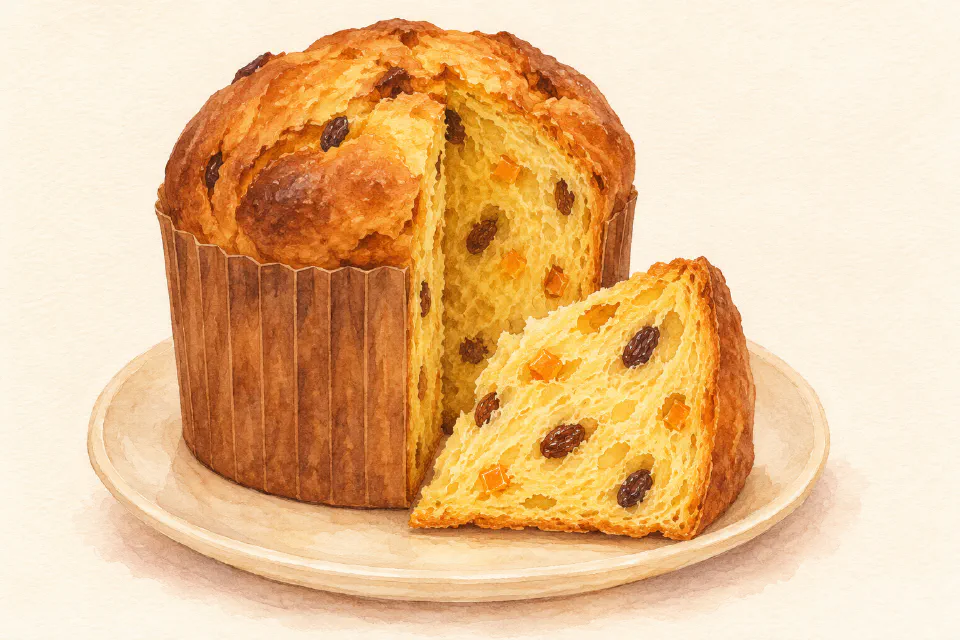
A home panettone made with baker’s yeast, strong flour, butter, raisins and candied orange peel. Includes proofing cues, a 1kg mould and upside-down cooling.
Ingredients
Have your ingredients ready? Go to instructionsInstructions
- Prepare fruit and equipment: Cover the raisins with warm water for 20 minutes, then drain thoroughly and pat dry. Set a freestanding oven-safe 1kg paper panettone mould, roughly 17cm wide and 12cm high, on a baking tray. Have two long sturdy food-safe metal skewers and two stable supports ready for inverted cooling; confirm the oven and cooling space can accommodate them.
- Mix the dough: In a stand mixer bowl combine the flour, yeast, sugar and salt. Add the milk, eggs, yolk, vanilla and citrus zests. Mix with the dough hook on low speed until a rough dough forms. Rest for 10 minutes, then knead at the speed recommended by the mixer maker for 8-12 minutes, until smoother and elastic.
- Work in the butter: Add the 80g softened butter a small piece at a time while kneading, letting each piece blend before adding the next. Continue for about 8-12 minutes until the dough is soft, glossy and stretches into a thin translucent membrane before tearing. Aim for a dough temperature of 24-26°C. If it approaches 28°C, pause and refrigerate the bowl briefly rather than adding extra flour.
- First rise: Knead in the well-drained raisins and peel on low speed just until distributed. Place in a lightly buttered bowl, cover and leave at about 24-26°C until roughly doubled, usually 2-4 hours. Mark the starting level on a straight-sided container if possible. Use the change in volume, not the clock alone.
- Shape and proof: Turn onto a lightly buttered surface and gently form a taut round without tearing the surface. Place seam-side down in the ungreased paper mould. Cover loosely with a roomy food-safe bag and leave at about 24-26°C until the central dome is about 1cm below the rim, usually another 2-4 hours. Keep the cover from touching the dough.
- Bake: Heat the oven to 170°C (fan 150°C) with a shelf low enough to leave room above the dome. Remove the cover. With a sharp blade make a shallow cross on top and place the remaining 10g butter in the centre. Bake for about 50-65 minutes. If the top darkens quickly, tent loosely with foil after the first 25-30 minutes. Check the centre from the side with a probe: aim for 92-94°C and no wet dough on a skewer. Continue in short intervals if needed.
- Suspend to cool: Immediately after baking, wearing oven gloves, pass two long metal skewers parallel through the paper mould and loaf about 2cm above the base. Carefully invert and rest the projecting skewer ends securely on two stable equal-height supports, with the loaf hanging clear of the surface below. Leave for at least 6 hours until completely cold; do not remove the paper mould.
- Slice: Turn upright, remove the skewers and slice only when fully cold. Peel paper away from the portion being cut rather than stripping it all off while the loaf is warm.
Panettone is an Italian Christmas bread also enjoyed in Malta. This baker’s-yeast home version uses a single enriched dough with raisins, candied orange peel and citrus zest. Expect a rich sweet bread; it is not a lievito-madre artisan panettone formula.
Equipment and Planning
You need a stand mixer with a dough hook, accurate scales, a probe thermometer, a freestanding 1kg paper panettone mould and two sturdy food-safe metal skewers long enough to bridge your cooling supports. Check the mixer’s dough capacity and recommended kneading speed before starting. The paper mould must be rated for oven use and suitable for suspended cooling; an ordinary paper cake liner is not a substitute.
The dough weighs roughly 950g before baking. Mould dimensions vary, so check the maker’s intended dough capacity as well as its nominal size. Prepare a stable place for the inverted loaf before the bake; do not improvise the support while holding hot bread.
Allow a full day for mixing, two rises and baking, then an overnight cooling period. The active preparation time excludes the soak, rises and cooling. A cool kitchen can extend the rising periods substantially.
Strong Flour and a Cool Dough
Use strong white bread flour with about 13-14% protein. Plain flour and gluten-free blends are not direct replacements in this formula. Add butter only after developing some elasticity, and keep it soft rather than oily or melted. The dough will be tacky: adding handfuls of flour to make it dry produces a heavy loaf.
If the dough heats up or looks greasy, pause the mixer and chill it briefly. Check for a thin stretchable membrane before adding fruit, which makes the stretch test harder to assess. Drain and dry the raisins well so they do not bring unmeasured soaking water into the dough.
Watch the Rise and the Centre
The butter and sugar slow fermentation. A warm cupboard above 30°C can melt the butter rather than help the dough, so aim for 24-26°C and allow time. Do not bake a clearly under-risen loaf just because the estimated proofing time has passed.
A dark dome can hide a wet middle. Use both the internal-temperature check and a skewer through the centre, keeping the probe away from the mould and a large piece of fruit. The final bake time depends on the mould, oven and proofing.
Inverted cooling supports the delicate warm loaf. Secure the skewers low in the mould, keep the supports stable and leave the bread hanging clear until cold. Cutting it warm can compress the crumb.
Serving and Keeping
Serve plain in thin slices. Once completely cold, keep wrapped in a closed food-safe bag in a cool dry place and eat within two days for best texture. Freeze slices for longer storage and thaw wrapped. This home version has no commercial preservation or weeks-long storage schedule.
It contains wheat, eggs and dairy. The raisins are soaked in water and this version has no added alcohol; check the candied peel and other ingredient labels when shopping.
Recipe Context
WhyChristmas’s account of Christmas in Malta identifies Italian panettone as a local Christmas favourite. King Arthur Baking’s overnight panettone is an example of a baker’s-yeast approach; that recipe uses an overnight preferment, while this home version uses a direct dough with its own proportions. The San Francisco Baking Institute describes inverted cooling as part of panettone making.
For a bake without enriched-dough proofing, try Christmas fruit cake. Find the rest of the menu in the Maltese Christmas collection.