Qagħaq tal-Għasel (Maltese Honey Rings)
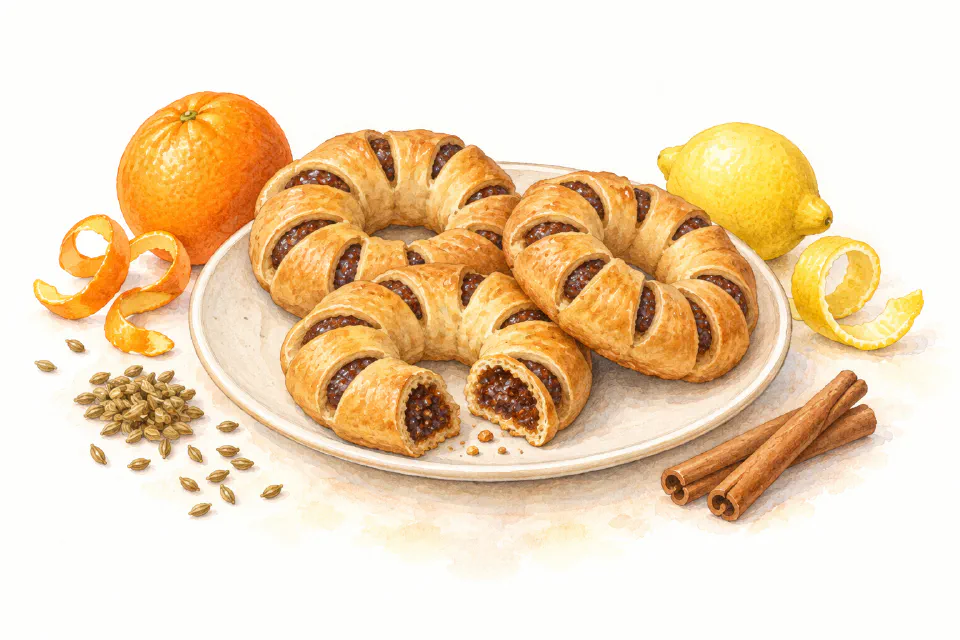
Traditional Maltese honey rings filled with treacle, citrus, spices, and semolina. A fragrant festive sweet with a rich, sticky centre.
Ingredients
Have your ingredients ready? Go to instructionsInstructions
- Make the pastry: Rub the butter or margarine into the flour and salt. Add water gradually to form a smooth, firm dough. Cover and rest for 30 minutes.
- Cook the filling: Warm the treacle, water, sugar, citrus zest, cinnamon, aniseed, cloves, and cocoa if using in a saucepan. Stir in the semolina and cook gently for 5-8 minutes until thick. Cool completely before shaping.
- Shape the rings: Preheat the oven to 180°C (fan 170°C). Roll the pastry into long strips about 8-10cm wide. Spoon the filling along each strip, fold the pastry around it, and seal the edge. Join the ends to form rings.
- Decorate: Make small slashes around the top of each ring with a sharp knife so the filling shows slightly.
- Bake: Place on a lined baking tray and bake for 20-25 minutes until the pastry is lightly golden. Cool before serving.
Qagħaq tal-Għasel are traditional Maltese honey rings, though the filling is usually made with treacle rather than honey. They are fragrant with citrus, spice, and aniseed, and are especially associated with Christmas and winter gatherings.
Ingredient Substitutions Outside Malta
Dark baking molasses can replace black treacle, as the ingredient list allows. Avoid blackstrap unless you want a much more bitter filling; honey and golden syrup change the flavour despite the name ‘honey rings’. Use wheat semolina, not instant couscous or cornmeal. See the treacle and semolina notes.
Serving Suggestions
- Serve at room temperature with coffee or tea
- Cut larger rings into slices for sharing
- Add to a Christmas sweet platter
- Store in an airtight tin once cooled
Traditional Notes & Tips
- Despite the name, treacle is the usual base for the filling
- The filling must cool before it is wrapped in pastry
- The small slashes are traditional and let the dark filling peek through
- Do not overbake; the pastry should stay relatively pale
- The flavour improves after a day of resting
Honey rings at Christmas
Camilleri records Qagħaq tal-Għasel among the sweets sold for Christmas and New Year, and describes their treacle filling. See Maltese Folklore, printed page 198.
The English name ‘honey rings’ does not mean that the recipe above contains honey: its filling uses treacle or dark molasses. The festive association is useful when planning a sweets table, but you can also bake these rings for coffee at another time of year.